
- Home ›
- USA Wind Zone I, II & III Map
USA Wind Zone I, II & III Map
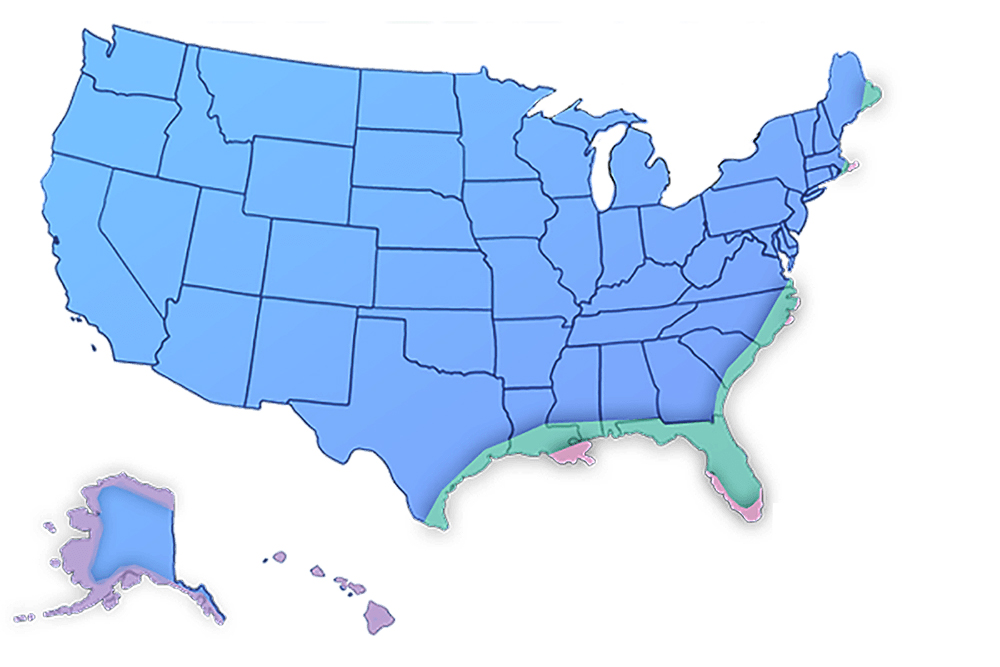
Every manufactured home must be designed according to the federal Manufactured Home Construction and Safety Standards at 24 CFR 3280, known as the HUD Code. The HUD Code stipulates, at §3280.305(c)(1) and §3280.305(c)(2), that the home shall be designed and constructed to conform to one of three wind load zones. The appropriate wind zone used in design is dependent on where the home will be initially installed. Homes designed and constructed to a higher Wind Zone can be installed in a lower Wind Zone (a Wind Zone III home can be installed in a Wind Zone I or II location). However, a Wind Zone I home cannot be installed in either a Wind Zone II or III area.
Wind loads (lateral) must be resisted by the home. The home must be capable of transferring these imposed lateral loads to the home’s stabilizing devices without exceeding the allowable stresses and other deflection requirements. Wind Zone I, Wind Zone II and Wind Zone III are identified on the basic wind zone map below. The manufactured home producer designs the home to resist the wind load, which is measured in pounds per square foot. Wind Zone I equates to a 70-mph fastest-mile wind speed. Wind Zone II equates to a 100-mph fastest-mile wind speed. Wind Zone III equates to a 110-mph fastest-mile wind speed.

Wind Zone Compliant Foundation & Anchoring Solutions from Oliver Technologies
Foundation Systems
Anchors & Components
Supporting Products
Frequently Asked Questions
Wind Zone I is the baseline, requiring resistance to 70 mph winds. It covers most inland U.S. areas away from hurricanes.
Use the HUD basic wind zone map (embedded on this page), check county lists in HUD regs, or consult local permitting offices. Your home’s data plate also shows the designed zone.
No — it violates HUD Code. Always match or exceed the site’s requirements.
110 mph fastest-mile, for the most hurricane-prone coastal regions.
Wind Zone I: Designed for up to 70 mph fastest-mile winds (baseline for most inland U.S. areas). Wind Zone II: Up to 100 mph (coastal/high-risk areas like parts of the Gulf/Atlantic coasts). Wind Zone III: Up to 110 mph (highest-risk hurricane zones, e.g., southern Florida, Hawaii, certain coastal parishes/counties). These are “fastest-mile” speeds per older ASCE standards; equivalent modern 3-second gusts are roughly 108 mph (Zone I), 150 mph (Zone II), and 163 mph (Zone III) with safety factors.
Refer to the HUD Basic Wind Zone Map (embedded on this page), or check the official HUD regulations in 24 CFR 3280.305(c) which list counties in Zones II and III (all others default to Zone I). Contact your local county permitting office or building department for confirmation, as boundaries can vary slightly by location. HUD provides resources and maps online for verification.
No. A home built for Wind Zone I cannot be installed in Zone II or III areas—it violates HUD Code and local installation standards. However, homes built to Zone II or III can be installed in lower zones (e.g., a Zone III home in Zone I). Always check the home’s data plate and consult local authorities before moving or installing.
The wind zone is printed on the home’s HUD data plate (inside a kitchen cabinet, bedroom closet, electrical panel, or utility area) and may also appear on the exterior HUD certification label (red metal tag). This includes the designed wind zone, date of manufacture, and other specs. All HUD-code homes built since 1976 have this.
Yes. Zone I typically requires basic diagonal frame ties/anchors for horizontal resistance. Zones II and III need additional vertical ties and stronger systems to resist uplift from higher winds. Oliver Technologies’ All Steel Foundation Systems (ASFS) can eliminate or reduce traditional anchors in Zone I and simplify requirements in Zones II/III—contact us at 1-800-284-7437 for compliant solutions.
It may fail permitting/inspection, void warranties, create safety risks during storms, or lead to insurance issues. Non-compliance can result in costly relocation, upgrades, or removal. Always verify the home’s data plate matches or exceeds the site’s zone before purchase or setup.
Wind zones were introduced in 1976 under the HUD Code, with major updates in 1994 (post-Hurricane Andrew) for stricter construction in coastal areas. Anchoring rules were enhanced in 2008. While based on older “fastest-mile” metrics, they include safety factors for real-world protection.
